 Austria
 Belgium
 Czech Republic
 Denmark
 English (world)
 Finland
 France
 Germany
 Italy
Italy Netherlands
 Poland
 Portugal
 Spain
Spain Sweden
 USA
USA


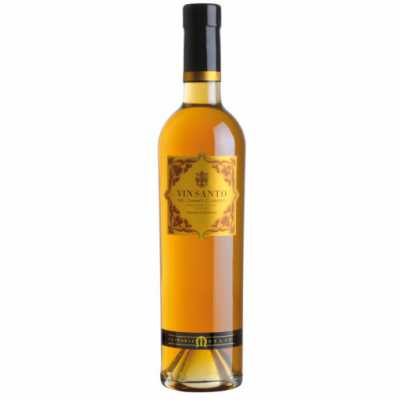
Märke: Melini
Vin Santo del Chianti Classico Doc
Occhio di Pernice
Grapes: 52% sangiovese – 48% canaiolo.
Vineyard: carefully selected parcels on the hills around Radda in Chianti (about 350 metres altitude) the vines are trained by the Guyot and cordone speronato systems, with a density of 3700 vines per hectare, on clayey-marl, rock based ground, with a good exposure.
Vinification: only the healthiest and ripest bunches are selected and these are picked by hand into wooden boxes; the grapes are left to dry on mats assembled on top of each other in dry and airy places until the spring following the vintage; the natural dehydration enriches the juice of the grapes which develops up to 18% alcohol; the dried grapes are then pressed and vinified in the traditional way.
Maturation: the must ferments very slowly (because of the high level of sugar) in small oak casks – the typical caratelli – in the Vinsantaia, an attic with a wide range of temperatures between day and night; the wine matures in wood for more than ten years before it is bottled.
Wine: deep amber colour, with strong tints; rich and concentrated bouquet of exceptional complexity, with hints of candied red fruits; full, balanced, complex, lingering flavour but, above all, extremely elegant with a well balanced rapport between sugar and acidity
Analytical details: 18.50% alcohol; 7.30 g/l total acidity; 3.41 pH; 99.10 g/l residual sugar; 42 g/l dry extract.
Optimum keeping: more than 15 years in bottles stored horizontally in cool, dark conditions.
Food matches: a wine for “meditation”, it can be enjoyed with dry pastries.
Serving temperature: 14°C
Tuscan Vin Santo belongs to the most ancient oenological civilization, the one of wines made from passiti (partially dried grapes). The peoples of Mesopotamia, of the Middle East and of the Mediterranean have always produced wines which can be transported and kept for a long time thanks
to the drying of the grapes. Passiti are also connected to the Christian tradition, because they are the preferred wines for the celebration of Mass. Vin Santo which, for centuries, has been used for the rite of Holy Communion appears to derive its name from the fact that the grapes from which it is made are left to dry until Holy Week, that of Easter, when they are crushed and pressed.
Vin Santo del Chianti Classico Doc
Occhio di Pernice
Grapes: 52% sangiovese – 48% canaiolo.
Vineyard: carefully selected parcels on the hills around Radda in Chianti (about 350 metres altitude) the vines are trained by the Guyot and cordone speronato systems, with a density of 3700 vines per hectare, on clayey-marl, rock based ground, with a good exposure.
Vinification: only the healthiest and ripest bunches are selected and these are picked by hand into wooden boxes; the grapes are left to dry on mats assembled on top of each other in dry and airy places until the spring following the vintage; the natural dehydration enriches the juice of the grapes which develops up to 18% alcohol; the dried grapes are then pressed and vinified in the traditional way.
Maturation: the must ferments very slowly (because of the high level of sugar) in small oak casks – the typical caratelli – in the Vinsantaia, an attic with a wide range of temperatures between day and night; the wine matures in wood for more than ten years before it is bottled.
Wine: deep amber colour, with strong tints; rich and concentrated bouquet of exceptional complexity, with hints of candied red fruits; full, balanced, complex, lingering flavour but, above all, extremely elegant with a well balanced rapport between sugar and acidity
Analytical details: 18.50% alcohol; 7.30 g/l total acidity; 3.41 pH; 99.10 g/l residual sugar; 42 g/l dry extract.
Optimum keeping: more than 15 years in bottles stored horizontally in cool, dark conditions.
Food matches: a wine for “meditation”, it can be enjoyed with dry pastries.
Serving temperature: 14°C
Tuscan Vin Santo belongs to the most ancient oenological civilization, the one of wines made from passiti (partially dried grapes). The peoples of Mesopotamia, of the Middle East and of the Mediterranean have always produced wines which can be transported and kept for a long time thanks
to the drying of the grapes. Passiti are also connected to the Christian tradition, because they are the preferred wines for the celebration of Mass. Vin Santo which, for centuries, has been used for the rite of Holy Communion appears to derive its name from the fact that the grapes from which it is made are left to dry until Holy Week, that of Easter, when they are crushed and pressed.
| Har du frågor om produkten? Skriv ditt svar (offentligt) så svarar vi så snart som möjligt |
Il vino contiene contiene solfiti.