 Austria
 Belgium
 Czech Republic
 Denmark
 English (world)
 Finland
 France
 Germany
 Italy
Italy Netherlands
 Poland
 Portugal
 Spain
Spain Sweden
 USA
USA


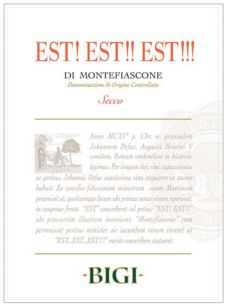
Märke: Bigi
Gradering : 12,0%
A wine still seldom seen outside the national boundaries, but for a very long time the most consumed and appreciated in Italy, perhaps also on account of the story of its name linked to a very ancient legend of the time of the Emperor Enrico V.* The Trebbiano Toscano, Malvasia Toscana and Trebbiano Giallo (locally called Rossetto) grapes, cultivated in the DOC zone of Montefiascone on the hills near Lake Bolsena, are vinified in steel tanks where the new wine develops until it is bottled.
*In 1111 the Bavarian prelate Johannes Defuc, on his way to Rome, sent ahead a servant by the name of Martino who had the job of showing him where you could drink good wine, marking the entrance of the inn with the monosyllable “Est” or, if the wine was particularly good, “Est Est”. At Montefiascone the expert servant found a wine so delicious that he wrote the fateful “Est” at least three times.
Est! Est!! Est!!! di Montefiascone DOC
Grapes: 65% Trebbiano Toscano (Procanico), 20% Malvasia Toscana, 15% Rossetto (Trebbiano Giallo).
Vineyard: selected vineyards in the DOC zone around Montefiascone, near Lake Bolsena, on hills of volcanic origin at 250-350 metres altitude; the vines are trained by the “Spalliera”, spurred cordon and “Palmetta” systems on soils of loose or medium texture, without much structure, with plenty of potassium and phosphoric carbon; the yield of wine is 84 hectolitres per hectare.
Vinification: the alcoholic fermentation and ageing for 4-5 months in stainless steel tanks.
Wine: bright, pale yellow colour; generous, distinctive bouquet, with a fresh fragrance of musk and hawthorn blossom and hints of ripe apples; dry, soft, balanced flavour with an elegant, lingering aftertaste of plums and bitter almonds.
Alcohol: 12% vol.
Optimum keeping: 1-2 years in bottles stored horizontally in cool, dark conditions.
Food matches: hors d’oeuvres, first courses, fish (especially freshwater fish), egg-based dishes.
Serving temperature: 10-12°C.
Gradering : 12,0%
A wine still seldom seen outside the national boundaries, but for a very long time the most consumed and appreciated in Italy, perhaps also on account of the story of its name linked to a very ancient legend of the time of the Emperor Enrico V.* The Trebbiano Toscano, Malvasia Toscana and Trebbiano Giallo (locally called Rossetto) grapes, cultivated in the DOC zone of Montefiascone on the hills near Lake Bolsena, are vinified in steel tanks where the new wine develops until it is bottled.
*In 1111 the Bavarian prelate Johannes Defuc, on his way to Rome, sent ahead a servant by the name of Martino who had the job of showing him where you could drink good wine, marking the entrance of the inn with the monosyllable “Est” or, if the wine was particularly good, “Est Est”. At Montefiascone the expert servant found a wine so delicious that he wrote the fateful “Est” at least three times.
Est! Est!! Est!!! di Montefiascone DOC
Grapes: 65% Trebbiano Toscano (Procanico), 20% Malvasia Toscana, 15% Rossetto (Trebbiano Giallo).
Vineyard: selected vineyards in the DOC zone around Montefiascone, near Lake Bolsena, on hills of volcanic origin at 250-350 metres altitude; the vines are trained by the “Spalliera”, spurred cordon and “Palmetta” systems on soils of loose or medium texture, without much structure, with plenty of potassium and phosphoric carbon; the yield of wine is 84 hectolitres per hectare.
Vinification: the alcoholic fermentation and ageing for 4-5 months in stainless steel tanks.
Wine: bright, pale yellow colour; generous, distinctive bouquet, with a fresh fragrance of musk and hawthorn blossom and hints of ripe apples; dry, soft, balanced flavour with an elegant, lingering aftertaste of plums and bitter almonds.
Alcohol: 12% vol.
Optimum keeping: 1-2 years in bottles stored horizontally in cool, dark conditions.
Food matches: hors d’oeuvres, first courses, fish (especially freshwater fish), egg-based dishes.
Serving temperature: 10-12°C.
| Har du frågor om produkten? Skriv ditt svar (offentligt) så svarar vi så snart som möjligt |
Il vino contiene contiene solfiti.