 Austria
 Belgium
 Czech Republic
 Denmark
 English (world)
 Finland
 France
 Germany
 Italy
Italy Netherlands
 Poland
 Portugal
 Spain
Spain Sweden
 USA
USA


Märke: Puglia Sapori e Dintorni
Format : 1 Kg.
Caciocavallo pugliese is a semi-hard cheese with spun dough, obtained from quality raw cow's milk, with the help of natural rennet and salt, with the use of grafting sera.
It is a cheese with a protected designation of origin (EC regulation No. 126/96 and its subsequent additions); the production area includes the territories of the regions of Calabria, Campania, Molise, Puglia and Basilicata. It owes its particular name to the ancient drying habit in pairs of shapes, tied together with a string of twine, straddled with sticks. While preserving the typical spinning process, its production technology is similar to that of long-matured cow's cheeses; it is in fact seasoned in controlled temperature and humidity cells, for at least 30 days. The technology is strictly codified by the official production disciplinary and provides for the lactic fermentation of the curd.
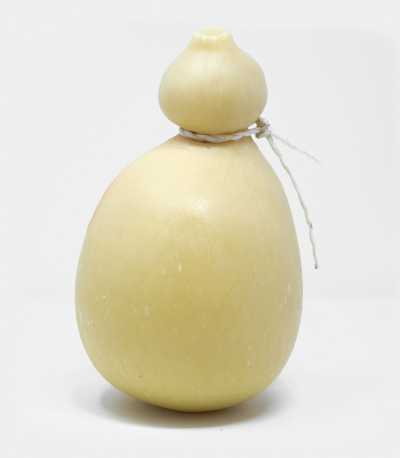
Its shape is oval, with short neck and head on body; the weight varies from a minimum of 1 kg to a maximum of 2.5 kg.
It has thin and smooth crust; the dough is homogeneous, compact with slight holes, light straw-colored. The taste is aromatic, pleasant, fused in the mouth, delicate and tendentially sweet in the young product, until becoming spicy with advanced aging. This depends mainly on the use of kid's rennet.
As the maturation progresses, the dough becomes more and more soluble in the mouth with characteristic peeling. It is one of the flagships of the entire Italian dairy tradition, unfailing in qualified tastes and in typical table cheeses; It should be served with quality red wines, medium-bodied, tannic.
Aged in suitable conditions it is also suitable for rasp, as a first seasoning with mixed ragout, with sheep meat.
Format : 1 Kg.
Caciocavallo pugliese is a semi-hard cheese with spun dough, obtained from quality raw cow's milk, with the help of natural rennet and salt, with the use of grafting sera.
It is a cheese with a protected designation of origin (EC regulation No. 126/96 and its subsequent additions); the production area includes the territories of the regions of Calabria, Campania, Molise, Puglia and Basilicata. It owes its particular name to the ancient drying habit in pairs of shapes, tied together with a string of twine, straddled with sticks. While preserving the typical spinning process, its production technology is similar to that of long-matured cow's cheeses; it is in fact seasoned in controlled temperature and humidity cells, for at least 30 days. The technology is strictly codified by the official production disciplinary and provides for the lactic fermentation of the curd.
Its shape is oval, with short neck and head on body; the weight varies from a minimum of 1 kg to a maximum of 2.5 kg.
It has thin and smooth crust; the dough is homogeneous, compact with slight holes, light straw-colored. The taste is aromatic, pleasant, fused in the mouth, delicate and tendentially sweet in the young product, until becoming spicy with advanced aging. This depends mainly on the use of kid's rennet.
As the maturation progresses, the dough becomes more and more soluble in the mouth with characteristic peeling. It is one of the flagships of the entire Italian dairy tradition, unfailing in qualified tastes and in typical table cheeses; It should be served with quality red wines, medium-bodied, tannic.
Aged in suitable conditions it is also suitable for rasp, as a first seasoning with mixed ragout, with sheep meat.
| Har du frågor om produkten? Skriv ditt svar (offentligt) så svarar vi så snart som möjligt |